Curators: 'Laboratorio 987' 2011 exhibition season: 'Amikejo', Museo de Arte Contemporáneo de Castilla y León (MUSAC), León, Spain

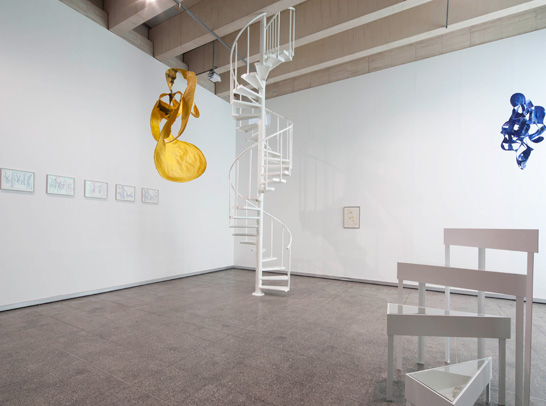
Uqbar, installation view. Courtesy the artists. Photo: Latitudes
Pennacchio Argentato (29 January–3 April 2011)
Iratxe Jaio & Klaas van Gorkum (9 April–12 June 2011)
Uqbar (Irene Kopelman & Mariana Castillo Deball) (25 June–11 September 2011)
Fermín Jiménez Landa & Lee Welch (24 September 2011–15 January 2012)
Amikejo was a series of four exhibitions by artist duos at MUSAC’s Laboratorio 987. Amikejo was a tiny state that existed from 1908–1920 between the Netherlands, Belgium and present day Germany and was founded on a desire to foster more effective international communication through the synthetic language Esperanto – Amikejo means ‘place of great friendship’ in Esperanto. This episode-place was a unique synthesis of cartography, language, nationhood, politics, economics and subjectivity, and was entreated as a twin site to Laboratorio 987 by lending its name and conceptual borders to the exhibition series.
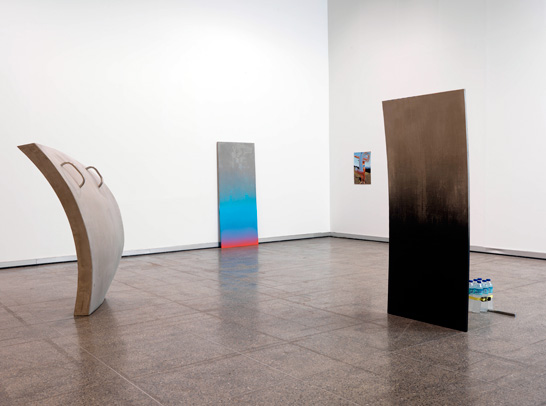
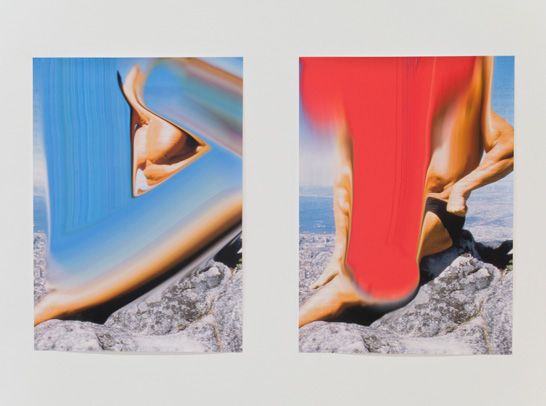
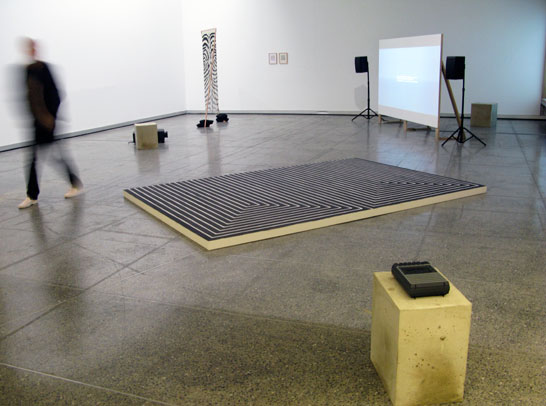
For the first exhibition, Neapolitan duo Pennacchio Argentato presented a new installation based on an exhibition's expectations of performance and interactivity. By transforming the Laboratorio 987 space into an interior akin to an abstract fitness gym, the duo framed their own activity by addressing the ideas of leisure and overproduction, work and non-work. A series of rough concrete “muscular” sculptures resembling prototypes for exercise machines seemingly promised engagement through, as the artists describe, “yet all without seeing or offering any end result”. Alongside the inactive machinery, a companion sculpture focussed more specifically on body building. An image of former professional bodybuilder Arnold Schwarzenegger revealing his muscles prompted a consideration, within the context of an art space, of a self-made aesthetics based on pose and theatricality. See video.
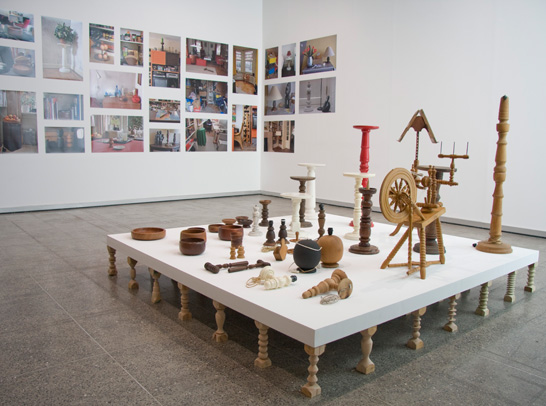
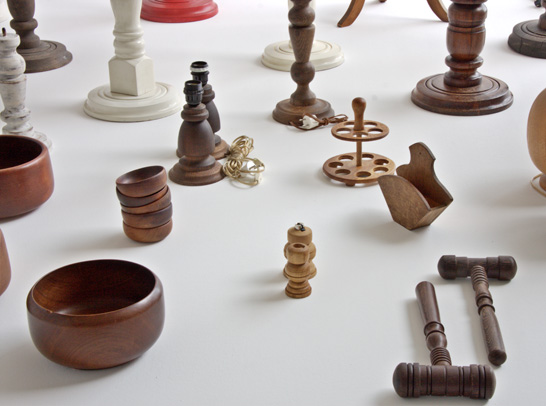
For the second exhibition, the Basque/Dutch duo Iratxe Jaio and Klaas van Gorkum took the woodturning hobby of a retired factory worker – Gorkum’s grandfather, Jos van Gorkum (1911–1996) – as the point of departure for a self-referential exploration of the notion of artistic production. Central to the exhibition was a selection of objects made by Jos van Gorkum which the artists were able to locate in the homes of family members across the Netherlands. Jaio and van Gorkum also learnt how to use the original lathe on which these items were made, connecting their own labour as artists to the spare-time activity of a pensioner. The by-products of this process were incorporated as the supporting elements of the platform on which the original objects were displayed. In addition three monitors showed a corporate film of the Lips Propeller factory where Jos van Gorkum worked before his retirement; the original lathe being used to make some of the 49 legs which support the platform; and the scanning of magazine clippings and sketches of wood-turned objects which had been collected in a cigar box. See video.
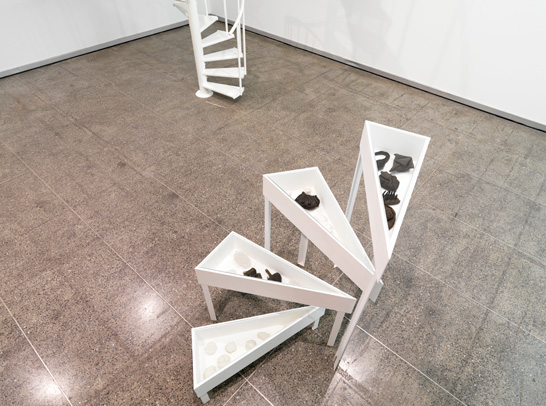
In the third chapter, uqbar (Irene Kopelman and Mariana Castillo Deball) explored the “interchanges, mutations, transmutations, metamorphosis and contaminations that working together entails... the not belonging to one or the other but rather creating an in between zone”, as the artists have described. The artists investigated the principal of chirality or ‘handedness’ – the property of an object that is not superimposable on its mirror image. Uqbar took this phenomenon as a metaphor of two organisms working together yet being completely different and alien to each other. The exhibition was composed of a spiral staircase, which served as a viewpoint for other artifacts and objects. Uqbar created a psychedelic chiral ecosystem, featuring hanging papier-mâché epiphyte sculptures and enlarged stone microfossils, as well as “Banyan tree drawings, a video of a chemical reaction, fables among non-humans and drawings of hybrid creatures”. See video.
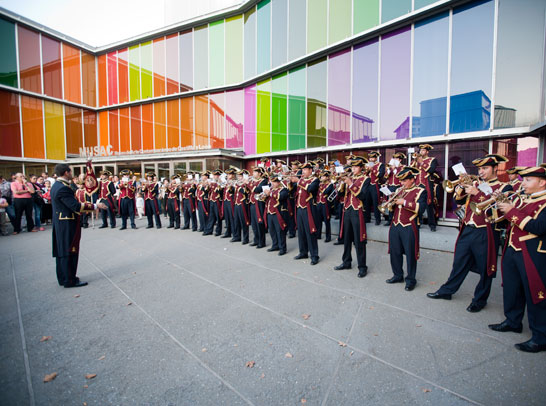
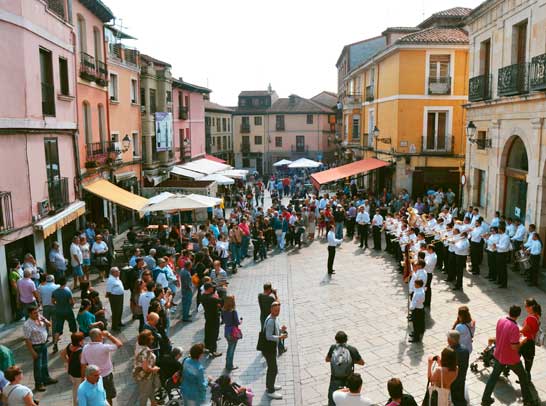
Fermín Jiménez Landa & Lee Welch did not know each other before the invitation to participate in Amikejo. As if engaged in international diplomacy, the artists had to understand each other personally and artistically before issuing a joint statement based on what they agreed and negotiated. Jiménez Landa and Welch chose to establish their collaboration in relation to the notion of the micronation and devices which delineate sovereignty – borders, stamps, anthems, and so on. Their works in MUSAC comprised a constellation of diverse elements, some of which were directly apparent in the Laboratorio 987, while others documented occurrences at remote locations, or existed only in the imagination. Portals or border markers hosted further two-dimensional and video works. A marching band from León was recruited to compose and perform a national anthem for a new autonomous island state and the founding of this micronation was documented in video and photography. See video.
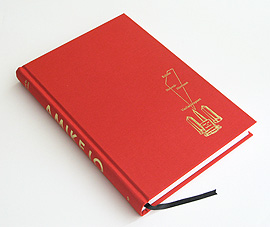
The publication (with Mousse Publishing) includes specially-commissioned essays by Peter Osborne (Professor of Modern European Philosophy and Director of the Centre for Research in Modern European Philosophy at Kingston University London); Ryszard Żelichowski (Professor and Director for Scientific Research at the Institute of Political Studies of the Polish Academy of Sciences); Theo Beckers (Former Professor of Leisure Studies at Tilburg University and currently faculty member of the Tilburg Sustainability Center and Visiting Professor of the Chinese Academy of Sciences); Prof. Dr. Menno Schilthuizen (Research scientist at NCB Naturalis, an endowed chair for Insect Biodiversity at the University of Groningen and an Associate Professor at Leiden University"; as well as texts on each project by the exhibition curators; reprints by Giorgio Agamben and Georges Perec, installation views and biographies of the artists. Purchase online.
Related links
Press MUSAC + images in high res; Press Release: Beginning of Amikejo with Pennacchio Argentato (January 2011); 'Amikejo: Pennacchio Argentato' inaugura el 29 Enero (16 January); Exhibition views of 'Amikejo: Pennacchio Argentato' (30 January); SAVE THE DATE: 9 April 2011 (25 March); Press Release: Opening of 'Amikejo: Iratxe Jaio & Klaas van Gorkum' (April 2011); Exhibition views of 'Amikejo: Iratxe Jaio and Klaas van Gorkum' (12 April); Video interview with Iratxe Jaio and Klaas van Gorkum (2 May); Opening 25 June, 17h: 'Amikejo: uqbar (Irene Kopelman & Mariana Castillo Deball)'; Press Release: Opening of 'Amikejo: uqbar', 25 June 2011 (20 June); Photo gallery of Uqbar's 'Amikejo' exhibition, on view until 11 September (20 August 2011); SAVE THE DATE: 24 September opening final 'Amikejo' show' (29 August 2011); 24 Septiembre, 19h: Inauguración última exposición del ciclo anual 'Amikejo' con Fermín Jiménez Landa & Lee Welch, Laboratorio 987, MUSAC, León (12 September 2011); Opening performance: 'Himno Nacional' (2011) by Fermín Jiménez Landa & Lee Welch (26 September 2011); Details of the forthcoming 'Amikejo' exhibition catalogue (6 October 2011); Update: Contents of the forthcoming publication (21 October 2011); Update: Contents of the forthcoming publication 'Amikejo' (24 October 2011); Mousse Publishing and MUSAC release the publication 'Amikejo' edited by Latitudes (10 April 2012); SAVE THE DATE: Presentation of the publication 'Amikejo' with artist Fermín Jiménez Landa. Tuesday 22 May, 20h at Múltiplos, Barcelona (8 May 2012); RECUERDA: Presentación de la publicación 'Amikejo': Martes 22 Mayo, 20h en Múltiplos (c/ Lleó 6, 08001 Barcelona) (17 May 2012); Launch of the publication 'Amikejo' at the border tri-point (drielandenpunt) where the Netherlands, Belgium and Germany meet, 2 June, 17h (29 May 2012); 2 June 2012: Book launch and exploration of former Amikejo (18 June 2012).
Comisarios: temporada 2011 Laboratorio 987: 'Amikejo', Museo de Arte Contemporáneo de Castilla y León (MUSAC), León, España

Fermin Jiménez Landa & Lee Welch, performance by the Agrupación Musical Santa Marta y Sagrada Cena. Photo: Latitudes
Pennacchio Argentato (29 Enero–3 April)
Iratxe Jaio & Klaas van Gorkum (9 Abril–12 Junio)
Uqbar (Irene Kopelman & Mariana Castillo Deball) (25 Junio–11 Septiembre)
Fermín Jiménez Landa & Lee Welch (24 Septiembre–15 Enero 2012)
Amikejo fue una serie de cuatro exposiciones a cargo de parejas de artistas en el Laboratorio 987 de MUSAC. Amikejo, un Estado minúsculo que existió de 1908 a 1920 entre los Países Bajos, Bélgica y lo que hoy es Alemania, se fundó sobre el anhelo de propiciar una comunicación internacional más efectiva mediante el lenguaje sintético del Esperanto – Amikejo significa ‘lugar de gran amistad’ en ese idioma. Este episodio-lugar fue una síntesis única de cartografía, lengua, nación, política, economía y subjetividad, que brindó el tratamiento de ubicación gemela del Laboratorio 987, prestando su nombre y sus fronteras conceptuales a la serie expositiva.
Para la primera exposición, el dúo napolitano Pennacchio Argentato presentó una nueva instalación basada en las expectativas de teatralidad e interactividad en los espacios expositivos. Al transformar el espacio del Laboratorio 987 semejando a un gimnasio absurdo y abstracto, el dúo aborda las ideas de ocio y superproducción, trabajo y el no-trabajo. La presentación de una serie de esculturas “musculosas” de hormigón en bruto como prototipos de máquinas de gimnasio, parecen prometer una interacción aunque como describen los artistas 'sin ofrecer o verse un resultado final'. Junto con esta maquinaria inmóvil y no-receptiva, se presenta una escultura con la imagen del ex-culturista Arnold Schwarzenegger exhibiendo sus músculos, la cual nos lleva a considerar, en el contexto de un espacio artístico, una estética hecha a sí misma a base de pose y teatralidad. Ver vídeo.
En la segunda exposición, el dúo vasco-holandés formado por Iratxe Jaio y Klaas van Gorkum, tomó la afición por el torneado de madera de un obrero industrial jubilado – el abuelo de Gorkum, Jos van Gorkum (1911–1996) – como punto de partida para una exploración autorreferencial del concepto de la producción artística. Como elemento central de la exposición se presentó una selección de objetos domésticos elaborados por Jos van Gorkum durante su jubilación, localizados por los artistas en los hogares de familiares, amigos y antiguos vecinos en los Países Bajos. Jaio y van Gorkum aprendieron a manejar el torno original con el que se fabricaron los artículos, vinculando su trabajo en tanto que artistas, con las aficiones de tiempo libre de un jubilado. Las 49 bases de madera que produjeron se incorporaron a la instalación como elementos de apoyo sobre las cuales se exhiben los objetos originales. Tres monitores mostraron una película corporativa de la fábrica de hélices Lipps en la que Jos van Gorkum trabajó antes de su jubilación; los artistas trabajando el torno y por último la digitalización de los recortes de revistas, dibujos y plantillas para realizar objetos de madera guardados en una caja de puros que el Jos van Gorkum legó a su hijo al morir. Ver vídeo.
Para la tercera exposición uqbar, colaboración puntual entre las artistas Irene Kopelman y Mariana Castillo Deball, exploró los "intercambios, mutaciones, transmutaciones, metamorfosis y contaminaciones implícitos en el trabajo conjunto... los híbridos que creamos juntas, que no pertenecen a una ni a otra sino que más bien generan una zona intersticial", en palabras de las propias artistas. La exposición giró entorno al principio de la quiralidad: la propiedad de un objeto que no se puede superponer sobre su imagen especular y se articuló entorno a una escalera espiral, desde la que se observaban otros artefactos y objetos. uqbar crea un ecosistema quiral psicodélico, con esculturas de epífitos en papier mâché y microfósiles de piedra ampliados, así como "dibujos de árboles banianos, un vídeo de una reacción química, fábulas de entes no-humanos y dibujos de criaturas híbridas". Ver vídeo.
Fermín Jiménez Landa y Lee Welch no se conocían antes de que se les invitara a participar en Amikejo. Como si fuera una cuestión de diplomacia internacional, los artistas tuvieron que entenderse mutuamente tanto en lo personal como en lo artístico antes de emitir una declaración conjunta, según lo acordado y negociado. Jiménez Landa y Welch escogieron establecer su colaboración en torno a la noción de “micro-nación” y los recursos que definen la soberanía: fronteras, sellos o himnos nacionales. En MUSAC presentaron un conjunto de elementos algunos de los cuales se advierten directamente en el Laboratorio 987, mientras que otros documentaron fenómenos en lugares remotos: esculturas que adoptan la forma de hitos fronterizos, además de albergar otras obras bidimensionales y de vídeo. Además se contrató a una banda de música de León para que compusiera e interpretara un himno nacional para un nuevo estado insular independiente, documentando la fundación de dicha micro-nación a través de video y fotografía. Ver video.
La publicación (Mousse Publishing, 2012) incluye textos sobre cada proyecto, así como contribuciones especiales de Peter Osborne (Profesor de Filosofía Europea Moderna y director del Centre for Research in Modern European Philosophy (CRMEP), Kingston University London); Ryszard Żelichowski (Profesor y Director de Investigación Científica, Instituto de Estudios Políticos de la Academia Polaca de Ciencias); Theo Beckers (Ex-Profesor de estudios del tiempo libre, Tilburg University y actualmente miembro del cuerpo facultativo del Tilburg Sustainability Center y profesor visitante de la Chinese Academy of Sciences); Prof. Dr. Menno Schilthuizen (Científico investigador, NCB Naturalis, Universidad de Groningen y profesor asociado de la Universidad de Leiden); reimpresiones de textos de Giorgio Agamben y Georges Perec; documentación gráfica de las exposiciones y biografías de los artistas. Compra online.
Enlaces relacionados
Sala Prensa MUSAC + imágenes en alta resolución; Nota de Prensa: inicio 'Amikejo' e inauguración Pennacchio Argentato (Enero 2011); 'Amikejo: Pennacchio Argentato' inaugura el 29 Enero (16 enero); Vistas exposición 'Amikejo: Pennacchio Argentato' (30 enero); SAVE THE DATE: 9 April 2011 (25 marzo); Nota de Prensa: Inauguración de 'Amikejo: Iratxe Jaio & Klaas van Gorkum' (Abril 2011); Vistas exposición 'Amikejo: Iratxe Jaio y Klaas van Gorkum' (12 abril); Video entrevista a Iratxe Jaio y Klaas van Gorkum (2 Mayo); Opening 25 June, 17h: 'Amikejo: uqbar (Irene Kopelman & Mariana Castillo Deball)' Nota de Prensa: Inauguración de 'Amikejo: uqbar' (20 Junio); Vistas exposición, uqbar's 'Amikejo' exhibition, on view until 11 September (20 agosto 2011); SAVE THE DATE: 24 September opening final 'Amikejo' show (29 agosto 2011); 24 Septiembre, 19h: Inauguración última exposición del ciclo anual 'Amikejo' con Fermín Jiménez Landa & Lee Welch, Laboratorio 987, MUSAC, León (12 septiembre 2011); Opening performance: 'Himno Nacional' (2011) by Fermín Jiménez Landa & Lee Welch (26 septiembre 2011); Details of the forthcoming 'Amikejo' exhibition catalogue (6 octubre 2011); Update: Contents of the forthcoming publication (21 octubre 2011); Update: Contents of the forthcoming publication 'Amikejo' (24 octubre 2011); Further update: Contents of the forthcoming publication 'Amikejo' (21 diciembre 2011); Mousse Publishing and MUSAC release the publication 'Amikejo' edited by Latitudes (10 abril 2012); SAVE THE DATE: Presentation of the publication 'Amikejo' with artist Fermín Jiménez Landa. Tuesday 22 May, 20h at Múltiplos, Barcelona (8 mayo 2012); RECUERDA: Presentación de la publicación 'Amikejo': Martes 22 Mayo, 20h en Múltiplos (c/ Lleó 6, 08001 Barcelona) (17 mayo 2012); Launch of the publication 'Amikejo' at the border tri-point (drielandenpunt) where the Netherlands, Belgium and Germany meet, 2 June, 17h (29 mayo 2012); 2 June 2012: Book launch and exploration of former Amikejo (18 junio 2012).