Curators: 'Portscapes', projects around Maasvlakte 2, the extension of the Port of Rotterdam, the Netherlands, throughout 2009


Portscapes
Photos: Freek van Arkel / Paloma Polo / Jan Dibbets

Archive | Archivo   Gallery | Galería   Videos | Vídeos

Project website:
www.portscapes.nl
Projects timeline: http://www.dipity.com/latitudes/PORTSCAPES

Artists:
Lara Almarcegui, Bik van der Pol, Jan Dibbets, Marjolijn Dijkman, Fucking Good Art, Ilana Halperin, Christina Hemauer & Roman Keller, Paulien Oltheten, Jorge Satorre, Hans Schabus. Website: Maria Barnas (poetry) and Markus Miessen (interviews)

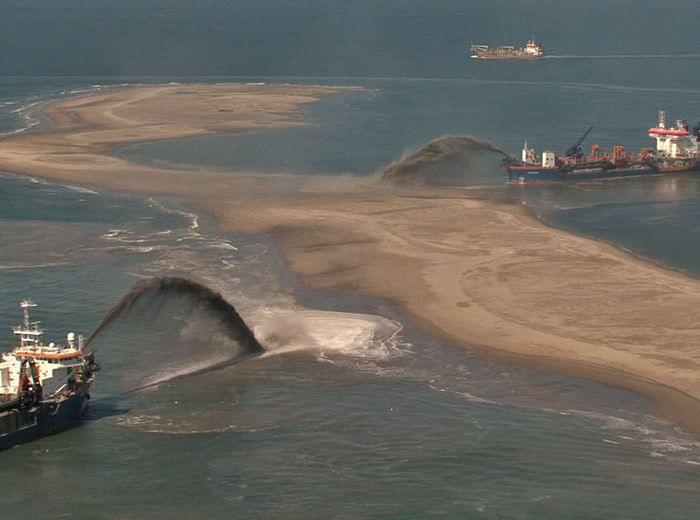
Portscapes’ was a series of newly commissioned projects initiated by the Port of Rotterdam Authority with advice and support from SKOR (Foundation for Art and Public Domain, Amsterdam) and curated by Latitudes. It was produced and presented throughout 2009 alongside the construction of Rotterdam's Maasvlakte 2 – the extension to Europe's largest seaport and industrial area which is being realised between 2008 and 2013 with 2,000 hectare area of reclaimed land (see images here). With the involvement of Dutch and international artists, 'Portscapes' aimed to consider the physical and conceptual implications of the new lands of Maasvlakte 2, as well as the city-port as a distributive network – a hub of exchange across different registers at once artistic, marine and mercantile.

'Portscapes' evolved around the leitmotif itineraries and destinations by creating events varied in size and scale such as temporary interventions, performances and site-specific audio tours. Portscapes unfolded as a cultural guidebook to the port area, exploring the material, historical, artistic, architectural, political, social, ecological pasts, presents and futures of the development as well as the ripe contexts of trade and energy. See images of Latitudes's site visits in May 2008.

'
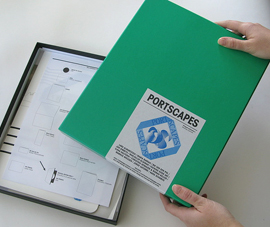
Portscapes' presented a prologue publication during Art Rotterdam (5–8 February 2009). This 'self-build' publication was designed by Ben Laloua / Didier Pascal with contributions by Jorge Satorre, Paulien Oltheten, Maria Barnas and Erick Wesselo amongst others.

Documentation of the projects was presented at the
Museum Boijmans van Beuningen, Rotterdam.

'
Portscapes' projects in chronological order by their presentations:

JAN DIBBETS, '6 Hours Tide Object with Correction of Perspective' (2009)
Flickr Slideshow
Production: 8 February; Presentation: screenings during June–July
Press Release
here | Press coverage here | Blog here and here | ‘Making of’ video here (part 1) and here (part 2)

The inaugural '
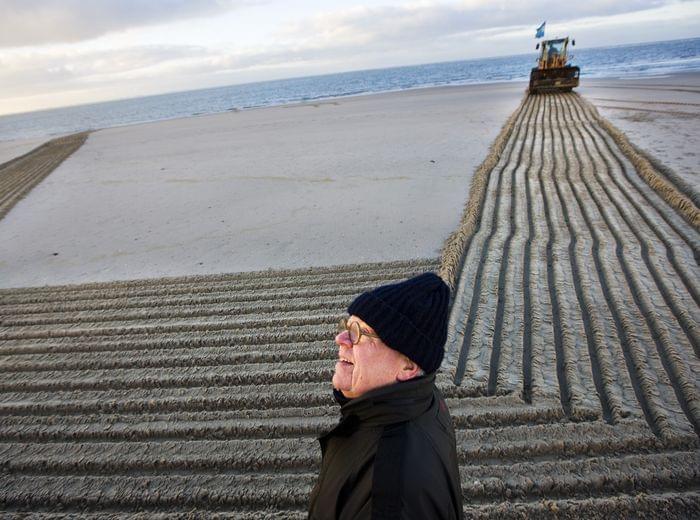
Portscapes' project took place on Sunday 8 February with the filming of '6 Hours Tide Object with Correction of Perspective' by the Dutch Conceptual artist Jan Dibbets (1941). Originally filmed in February 1969 in black and white 16 mm and titled '12 Hours Tide Object...', the film was included in Gerry Schum's seminal 'Land Art' series of films screened that same year on German public TV. The film presents the drawing of an isosceles trapezoid in the sand using a bulldozer – the shape consequently appears as a rectangle in the resultant film due to the angle of perspective. The new 2009 realisation was filmed 40 years later to the month on the beach of the Maasvlakte, an area that was soon to be transformed with the construction of Maasvlakte 2. The resulting 8 minute-long film was premiered in the Futureland (14 June, 22 June, 29 June and 5 July) and during Latitudes' participation in the New York festival NO SOUL FOR SALE.

With thanks to Fijko van Leeuwen, cameraman; Jan Vader, bulldozer driver; Jan Willem Stoof, hydraulic lift operator and Olaf Schuur, 'Making of' cameraman and montage.


HANS SCHABUS, 'Europahaven, Rotterdam, 17 juni 2009' (2009)
Flickr slideshow
Production: June; Presentation: 1 July–30 September in Futureland
Press Release
here | Blog here | Text Metropolis M (Dutch) | ‘Making of’ video here

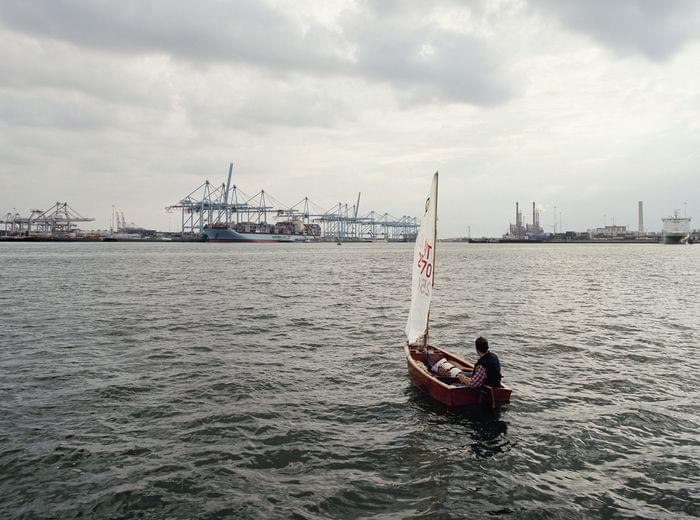
Hans Schabus’ project was the next chapter in his ongoing series of ‘arrival photographs’ featuring the sailing boat Forlorn. The artist produced a new photograph, titled 'Europahaven, Rotterdam, 17 juni 2009' which could be seen on a 5 by 9 m roadside billboard on the way to Maasvlakte, and was also distributed as a postcard, available from the Port visitors’ centre Futureland. In the new image the sailor navigates towards the huge container terminals of the Port of Rotterdam and a vast cargo ship. Sailing at a point which would become the new entrance to Maasvlakte 2, the simplest of water vehicles and a single man appeared in stark contrast to an overwhelmingly modern manifestation of seafaring trade. Despite the speed, scale and efficiency of the port, the image seemed to indicate that on a human scale the vastness of maritime space nevertheless remains a vulnerable and mythologically rich territory.

With thanks to Claus Föttinger, The Wien Museum, Kerstin Engholm from Engholm Englelhorn Galerie and Freek van Arkel.


PAULIEN OLTHETEN, 'Great if two pairs of legs are synchronized for a moment' (2009)
Flickr Slideshow
Production: Spring; Presentation: 14 August, FutureLand exhibition October–November 2009
Press Release here | Blog here | ‘Making of’ video here

Over the spring and summer months of 2009
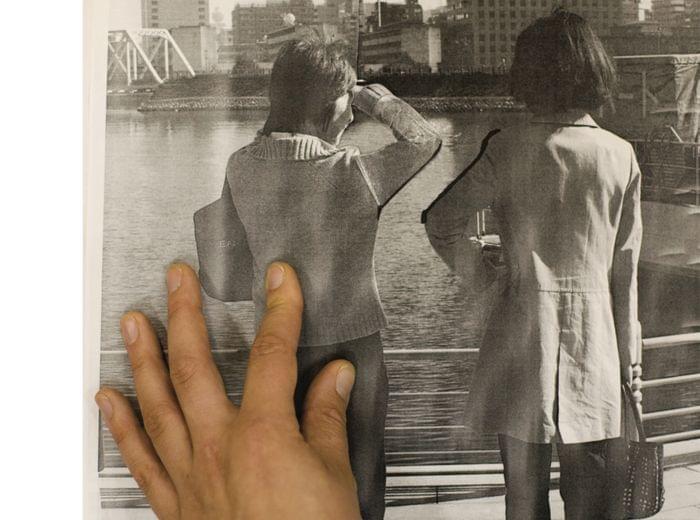
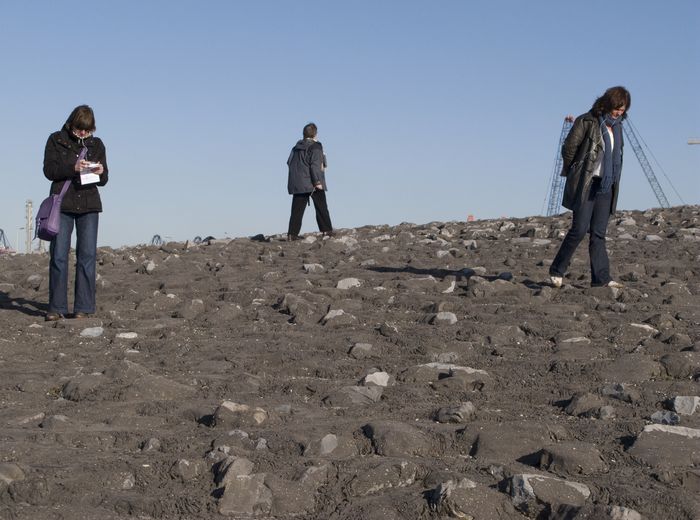
Paulien Oltheten made repeated visits on foot and bicycle to Maasvlakte by ferry from the Hook of Holland. Through chance encounter, intuitive and a sensitivity for the implicit, she witnessed and interacted with fishermen, ship enthusiasts, dog walkers and site workers. On 14 August 2009 a billboard with an image produced during her visits was placed along the A15 on the Maasvlakte. Oltheten made use of the lack of reference of natural elements, such as trees, bushes and people by staging actions. These stagings mostly took place in locations on the Maasvlakte that would soon disappear or be displaced and often involved variations of the theme ‘one becomes two’, referring to the Maasvlakte – of which there would later be two. This resulted in a series of photographs and two video pieces, which were seen during October in and around the visitor centre Futureland.


FUCKING GOOD ART (Rob Hamelijnck and Nienke Terpsma), 'Portscapes_ON AIR Station Maasvlakte' (2009)
Flickr Slideshow
Production & presentation
: 21 August–21 September. Broadcasts on www.portscapes.nl
Press Release here | Radio interview, RTV Rijnmond here (in Dutch) and here | Blog here | ‘Making of’ video here

Rob Hamelijnck and Nienke Terpsma, the artists and editors of Rotterdam-based magazine Fucking Good Art (www.fuckinggoodart.nl) were ‘embedded’ on Maasvlakte for a month during August–September 2009 from where they produced Portscapes_ON AIR Station Maasvlakte. Comprising a series of audio walks, field recordings and conversations with guests from different disciplines Portscapes_ON AIR Station Maasvlakte was broadcast on Portscapes' website (www.portscapes.nl). Inspired by their camp’s proximity to the pipeline which carried sand from the Yangtzehaven to the future Maasvlakte 2, the editors of FGA approached their endeavour both as inhabitants of an industrial and man-made territory and in relation to the redistribution and displacement of knowledge. Alongside other grand movements of transportation and trade taking place in the port, FGA’s broadcasts took shape through encounters with others and considered the role that art and artists have in other registers of exchange. Starting from the principal that in order to really understand a place one needs to really inhabit it, and the question of how to represent a place like Maasvlakte 2 which does not yet fully exist, the editors of FGA also aimed to stimulate discussion about the representation of Dutch landscape.

Portscapes ON_AIR is a collaborative effort of: Frank Bruggeman, designer, artist and editor of Club Donny; Hans Aarsman, columnist 'De Volkskrant' and writer; Remko Andeweg, botanical analyst Lino Hellings, Errorist and editor of P.A.P.A., and Rob van Maanen; Gijsbert Korevaar, industrial Ecologist; Aurélie Barbier, urban planner; Martin Blum, artist and farmer; Marjolijn Kok, theoretical archeologist; Line Kramer, artist – drawing; John Lonsdale, architect; Maarten Jansen, Hydraulic engineer and morphologist; Achilleka Komguem, artist, and Lionel Manga, writer.

FGA would also like to thank: Menno Steenman and Sjoerd Figdor, Port of Rotterdam; Roeterink, assistance and building our working  sleeping unit; Erik de Plaa and Jaap Korshuize from Delta, green power from Wind turbine; Bas van de Brand and PUMA, container; Eelco Muns, PUMA; Sander Boom, captain of The Spirit; Mooike de Moor, Radio Rijmond; Erik Post, Radio Rijmond; Maarten de Reus, artist, aerial photography; Helmi Weststrate; Roderick Hietbrink, artist - recording equipment.


ILANA HALPERIN, ‘A Brief History of Mobile Landmass' (2009)
Flickr Slideshow
Presentation: 18 September 2009. Audioguide available online and at Futureland in English/Dutch, until 2013. Duration: 45 min.
Press Release here | Blog here | ‘Making of’ video here

As her contribution to
Portscapes, New York-born Glasgow-based artist Ilana Halperin created an audio field guide available on MP3 players and online which visitors can pick up at Futureland until 2013 and experience by wandering around the nearby area of the port edge. ‘A Brief History of Mobile Landmass’ was inspired by a perception of Maasvlakte 2 in terms of formidable geophysical phenomena and a geological sense of time. This 'book on tape' gathered a compelling narrative of fragments which drew on fact, fiction and personal fieldwork – as well as site surveys by volcanologists, geologists and the experts involved in the construction of Maasvlakte 2. It offerred echoes, speculations and interpretations surrounding both the artificial and natural processess whereby new land is created. Recalling Jules Verne’s ‘Voyages Extraordinaires’, Halperin coupled a wealth of scientific information with wonder and vivid description.

With thanks to Will Borst, engineer; Sound design, Navy & Grey; Sytze van Heteren, geologist; Dr. Karen Holmberg, volcanic archeologist; Andrea Otte, marine archeologist; Dr. Hugh Tuffen, volcanologist; Tiedo Vellinga, coastal morphologist; Ronald Nadorp/Bob Kommer Studios; Bas Bökenkamp, Dutch voice for Ilana Halperin audioguide.


JORGE SATORRE, 'The Erratic. Measuring Compensation' (2009–10)
Flickr Slideshow
Production & presentation: First part in October 2009, second part in February 2010
Press Release here | Blog here and here | ‘Making of’ video here

During Satorre's 3-month residence in Rotterdam, he was searching for, and located, a large
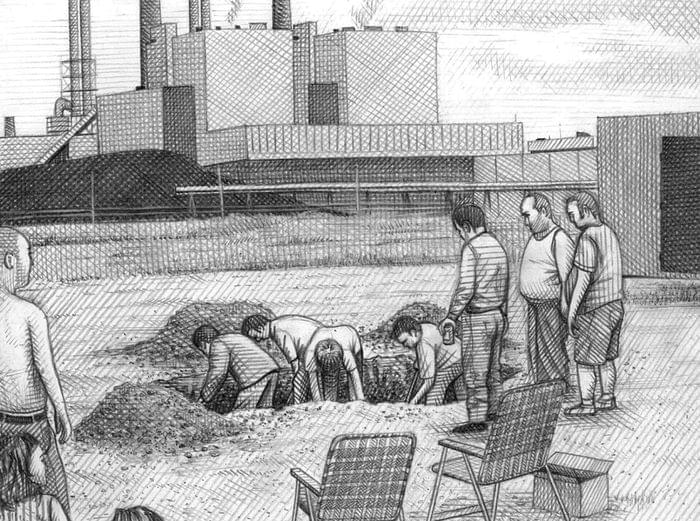
boulder – one of the many giant rocks carried by glaciers into the Netherlands from Scandinavia during the last Ice Age. Following the artist’s fascination with the compensation projects being instigated in order to ‘offset’ the construction of Maasvlakte 2, his project sought to identify the rock’s place of origin and return it to where it came from (southern Sweden) – an act of symbolic restitution and fundamental sculpture process. The transposition mirrored the monumental construction of the Maasvlakte as a sculpting of land-form which, like the action of glaciers but in a far shorter time, fundamentally alters the morphology of the Netherlands. The action was also mirrored in the fact that much of the existing and future sea defense in the port area was made from rock brought from Scandinavia. The artist’s accompanying drawings offerred an account of the process which incorporated both actual and imagined details, like a storyboard. A drawing depicting an imagined protest at the beginning of the boulder’s journey was realised as a billboard located on the A15, joining those by Hans Schabus, Paulien Oltheten and Marjolijn Dijkman.

With thanks to Erik Cammeraat, University of Amsterdam; Remco van Diepen, Nieuw Land Studiecentrum; Jannes van Echten, Stone garden, Hunebedcentrum; Hans van Essen; Hans Hooghart; Harry Huisman; Paloma Polo, artist and photographer; Eelko Postma, KNAG-Royal Dutch Geographical Society; Elna Svenle, Curator, Wanås Foundation; Tiedo Vellinga; Jaap Venvliet; Marika Wachtmeister, Director, Wanås Foundation; Wim Westerhoff, Geological Survey of the Netherlands and Jorge Aviña.


LARA ALMARCEGUI, 'Wastelands of the port of Rotterdam' (2009)
Flickr Slideshow
Presentation: 8 November
Press Release here | Blog here | ‘Making of’ video here

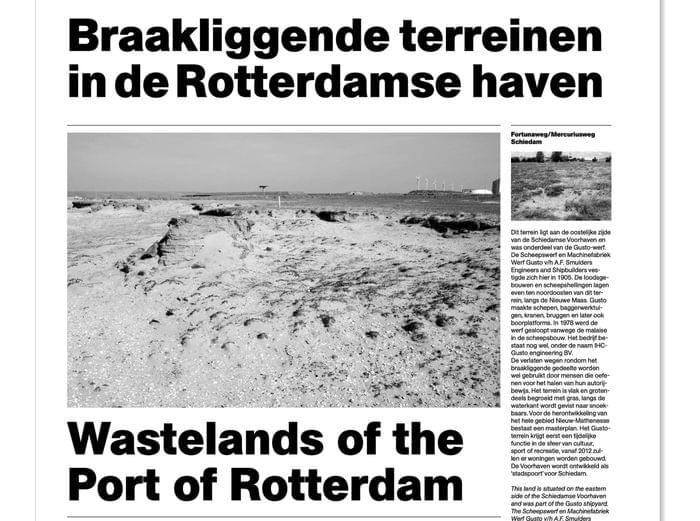
Lara Almarcegui developed a newspaper project concerning the ‘
wasteland’ areas which can be encountered throughout Rotterdam port, including the existing Maasvlakte. In contrast to the vast planning involved in MV2, she was interested in the spaces which were defined by an apparent lack of human design and development, which in turn relate historical legacies and changing land-use practices. The public could experience the port as an interconnected territory through self-determined tours as well as a botany excursion to a selected sites. For the project presentation on 8 November 2009, Almarcegui gave a tour together with Rotterdam-based biologist Remko Andeweg.

With thanks to Edgard Vervaecke, British Petroleum; Remko Andeweg, Bureau Stadsnatuur Rotterdam; Sjaak Poppe, Havenbedrijf Rotterdam N.V.; Floor Koomen, graphic designer; Martine van kampen, freelance writer and curator.


CHRISTINA HEMAUER & ROMAN KELLER. 'The Postpetrolistic Internationale' (2009)
Flickr Slideshow
Presentation: performances 7 and 8 November
Press Release here | Blog here and here | ‘Making of’ video here

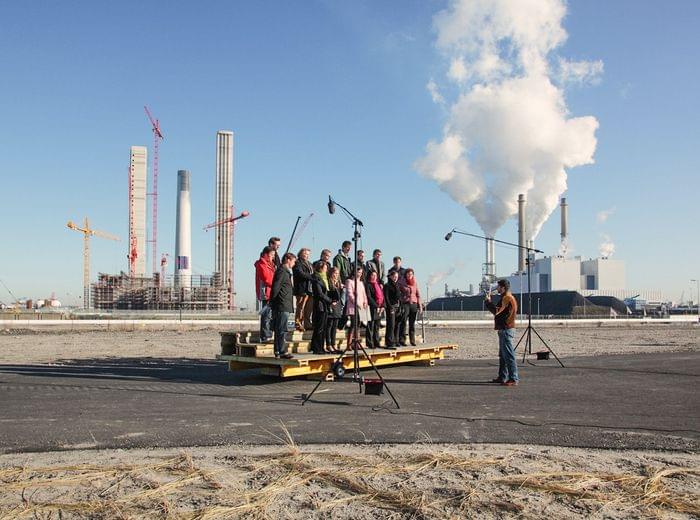
'The Postpetrolistic Internationale', Hemauer/Keller’s project for Portscapes, started with the transportation of a wooden stage along the Rhine from Basel, near the artists’ home, to Rotterdam. Upon arrival a choir performed the Postpetrolistic Internationale, a song that emerged from the medium of the collective human voice, and the tradition of the aspirational social anthem alongside the artists’ long standing interest in energy use. At two different locations (the old port in the city centre and overlooking the construction of Maasvlakte 2) local choirs performed this song of hope-in-action on the stage, against a backdrop of local industry, to mark man’s changing relationship with fossil fuels and energy use.

This project has been made possible thanks to the support from Pro Helvetia. Thanks are also extended to Brian Burman, musician and translator; Fermate, choir; Haags Ad Hoc, choir; Monique van Dalen and Stephan Warmenhoven, Bureau voor Audiovisuele communicatie, Het Kader; Kammerchor Basel, choir; Jason Klimatsas, assembler; Ernst Ledermann and Christoph Nicolay, Ultra-Brag AG; Mathias Vetter, composer; Fred LeComte/LeComte; Monica Lundström/Havenmuseum.


MARJOLIJN DIJKMAN, 'Surviving New Land' (2009–10) and ‘Here be dragons’ (2009)
Flickr Slideshow
Presentation
: ‘Here be dragons’ (2009) billboard placed on November 2009; film premiere 5 February 2010, Museum Boijmans van Beuningen, Rotterdam
Blog
here and here | Artists' website about the project here.

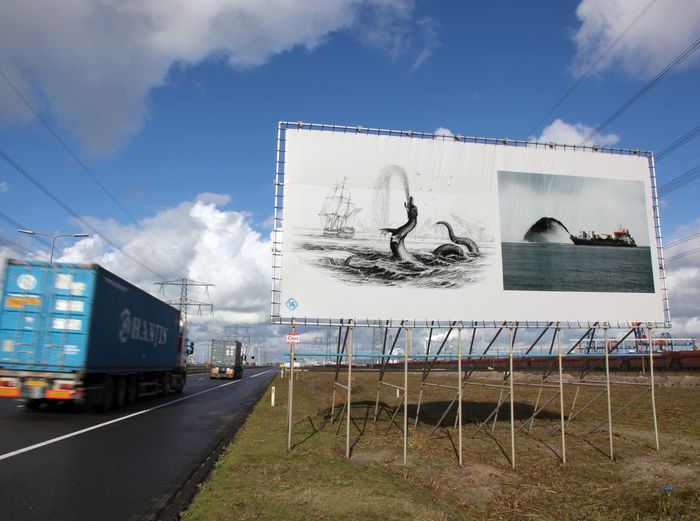
Dijkman’s project for Portscapes was inspired by the blank spots on old navigational charts which declared “Here Be Dragons”. Alongside the motifs of the ‘unknown island’ and sea monsters in literature and popular culture, she developed her video-based work by drawing on the mythological and monstrous potential which surrounds the new piece of Dutch land which has come into being with the emergence of Maasvlakte 2 from the sea. An image of Dijkman's research was presented as a billboard joining those by Hans Schabus, Paulien Oltheten and Jorge Satorre and acting as a prologue to her film which was premiered at the
Portscapes exhibition at the Museum Boijmans van Beuningen, Rotterdam.

With thanks to Maarten Vanden Eynde, artist; Bas Helbers, photographer; Nikolai Geworg Khatchatouryan, cameraman / compositor; Allard Zoetman, editor / compositor; David Gabriël Djindjikhachvili, artist / filmmaker; Henk Hendriksen, 'Broadcastorganisers'; Harmen van Eersel, 'Visual Music'; Hans Egede, artist (1686 - 1758); Maarten Roeper, 'Puma'; Etienne Koman, 'Puma'; Jurjen Semeijn.


BIK VAN DER POL, 'Facts on the Ground' (2009–10)
Presentation
: film premiere 5 February 2010, Museum Boijmans van Beuningen, Rotterdam

Bik van der Pol’s project was concerned with the definition of the design of Maasvlakte 2. What directed the choice for its location? What role did poetics and aesthetics play in this enormous process and typically Dutch undertaking?
Their project consisted of a film in which they “roughly and continuously circle over and around the Maasvlakte 2 site from the air, approaching the location like prey, recreating the drawn maps that represent the planning of MV2. Using the helicopter as a pencil and the film material as the paper traces will be left.” The film was premiered at the Portscapes exhibition at the Museum Boijmans van Beuningen, Rotterdam.

With thanks to Sjoerd Figdor, Cees Pons, Jan Konter, Gijsbert Kant, Tiedo Vellinga, all Rotterdam Port Authority and Arie Heystek, PUMA, consortium contractors Maasvlakte 2


Projects by Cyprien Gaillard, Michael Rakowitz and Jun Yang were not realised.


Comisarios: 'Portscapes', proyectos entorno al Maasvlakte 2, extensión del Puerto de Rotterdam, Holanda, a lo largo del 2009


Portscapes
Foto: Paulien Oltheten

Archive | Archivo   Gallery | Galería   Videos | Vídeos

Web del proyecto:
www.portscapes.nl (Holandés/Inglés)
Calendario proyectos: http://www.dipity.com/latitudes/PORTSCAPES

Artistas: Lara Almarcegui, Bik van der Pol, Jan Dibbets, Marjolijn Dijkman, Fucking Good Art, Ilana Halperin, Roman Keller & Christina Hemauer, Paulien Oltheten, Jorge Satorre, Hans Schabus. Web: Maria Barnas (poesía) y Markus Miessen (entrevistas).

Portscapes fue una serie de proyectos encargados por la Autoridad Portuaria de Rotterdam con el consejo y apoyo de SKOR (Foundation for Art and Public Domain, Amsterdam) y comisariados por Latitudes. ‘Portscapes’ tuvo lugar a lo largo del 2009 en el espacio público del puerto de Rotterdam, paralelamente a la construcción del Maasvlakte 2 (MV2), la extensión de la zona portuaria e industrial más extensa de Europa que se realizará entre el 2008 y 2013 'robándole' 2,000 hectáreas de terreno al mar (imágenes aquí). Con la participación de diez artistas (inter)nacionales, ‘Portscapes’ examinó las implicaciones físicas y conceptuales de los nuevos horizontes de Maasvlakte 2, así como la entidad ciudad–puerto como una red de distribución – un centro de intercambio a través de diferentes registros a la vez artísticos, marinos y mercantiles.

'Portscapes' tuvo como eje central el leitmotiv itinerarios y destinaciones. Creando eventos de escala y temporalidad variable, 'Portscapes' presentó performances, excursiones, tours con audioguías, esculturas efímeras y proyecciones, con la intención de actuar como una guía de la zona portuaria, explorando el pasado, presente y futuro ecológico, la historia, lo arquitectónico, lo político y social de esta zona, así como las materias importadas y exportadas, el comercio y la energía que se generan y gestionan en MV2.

Durante
Art Rotterdam (5–8 Febrero 2009) Portscapes distribuyó una ‘publicación prólogo’ diseñada por Ben Laloua / Didier Pascal con colaboraciones de Jorge Satorre, Paulien Oltheten, Maria Barnas y Erick Wesselo, entre otros.

Los proyectos se expusieron en el
Museum Boijmans van Beuningen, Rotterdam (30 Enero–25 Abril 2010).

Descripción de los proyectos presentados, siguiendo el orden cronológico:

JAN DIBBETS, '6 Hours Tide Object with Correction of Perspective' (2009)
Flickr Slideshow
Producción: 8 Febrero; Presentación: proyecciones durante Junio y Julio
Nota de prensa
aquí | Producción y cobertura prensa aquí | Blog aquí y aquí | Video ‘Making of’ aquí (parte 1) y aquí (parte 2)

El
8 Febrero 2009 tuvo lugar el proyecto inaugural de 'Portscapes' con la filmación de '6 Hours Tide Object with Correction of Perspective' del artista conceptual holandés Jan Dibbets. Realizada por primera vez en febrero de 1969 en 16mm y titulada '12 Hours Tide Object...', el film se incluyó en la legendaria compilación de películas 'Land Art' producidos por el también artista y productor Gerry Schum y emitidas en la televisión pública alemana en Abril de ese mismo año. La nueva filmación, tuvo lugar exactamente cuarenta años después en la playa del Maasvlakte, una zona que sufrirá profundos cambios en los próximos meses con la construcción del Maasvlakte 2. En la película vemos a una excavadora dibujando un trapecio isósceles en la arena, forma que aparecerá como un cuadrado en la película resultante debido al ángulo de perspectiva que se obtiene desde la cámara situada sobre la plataforma desde la que se filmó. La subida de la marea subsecuentemente borra el diseño del trapecio/cuadrado. El film se proyectó en el centro de visitantes FutureLand (14 Junio, 22 Junio, 29 Junio, 5 Julio) y durante la participación de Latitudes en el festival neoyorkino NO SOUL FOR SALE.

Agradecimientos: Fijko van Leeuwen, cámara; Jan Vader, conductor tractor; Jan Willem Stoof, operador grúa hidráulica y Olaf Schuur, 'Making of' cámara y montaje.

HANS SCHABUS, 'Europahaven, Rotterdam, 17 juni 2009' (2009)
Flickr slideshow
Producción: Junio; Presentación: 1 Julio–30 Septiembre
Nota de prensa
aquí | Blog aquí | Texto Metropolis M (Holandés) | Video ‘Making of’ aquí

El proyecto del austríaco Hans Schabus fue un nuevo capítulo en la serie fotográfica de 'llegadas' donde vemos al navegante/artista rodeado del skyline de ciudades tales como Nueva York, Venecia, Frankfurt o Bregenz. La fotografía 'Europahaven, Rotterdam, 17 Juni 2009' (véase aquí) producida para Portscapes, muestra al protagonista en la zona que se convertirá en la nueva entrada del futuro Maasvlakte 2, rodeado del vasto y populado paisaje de buques, grúas, contenedores de carga, tuberías y centrales térmicas del Puerto de Rotterdam. A pesar de la velocidad, la escala y la eficiencia del puerto, la imagen parece indicar que a escala humana la inmensidad del espacio marítimo sigue siendo vulnerable y mitológicamente rica. La imagen se presenta en una valla publicitaria de 5 x 9 metros situada en la zona portuaria así como en una postal disponible gratuitamente desde el centro de visitantes FutureLand.

Agradecimientos: Claus Föttinger, The Wien Museum, Kerstin Engholm from Engholm Englelhorn Galerie and Freek van Arkel.


PAULIEN OLTHETEN, 'Great if two pairs of legs are synchronized for a moment' (2009)
Flickr Slideshow
Producción: Primavera/Verano; Presentación: 14 Agosto (valla) y exposición Octubre–Noviembre en FutureLand y alrededores
Nota de prensa
aquí | Blog aquí | Video ‘Making of’ aquí

Durante la primavera y verano Oltheten realizó repetidas visitas a pie y en bicicleta a Maasvlakte. A través de encuentros casuales, intuitivos y una sensibilidad implícita, fue testigo, en ocasiones interviniendo, de la interacción de pescadores, entusiastas de buques y de trabajadores del puerto. El
14 de Agosto se instaló una de sus fotografías en una valla publicitaria en la A15 de Rotterdam, a 1km de FutureLand, el centro de visitantes. La falta de referencias de elementos naturales como árboles, arbustos o personas en la zona portuaria, llevó a Oltheten a recrear encuentros perpetuados en una serie de fotografías y dos piezas de vídeo. Estos encuentros tuvieron lugar en diferentes zonas del puerto, que pronto van a desaparecer o ser desplazados, y a menudo surgen como variaciones entorno a la multiplicación, el "uno se convierte en dos", refiriéndose al proyecto de extensión MV2.

FUCKING GOOD ART (Rob Hamelijnck and Nienke Terpsma), 'Portscapes_ON AIR Station Maasvlakte' (2009)
Flickr Slideshow
Producción y presentación: 21 Agosto–21 Septiembre. Retransmisión online www.portscapes.nl
Nota de prensa aquí | Entrevista radio RTV Rijnmond aquí (en Holandés) y aquí | Blog aquí | Video ‘Making of’ aquí

Los editores de la revista de Rotterdam FUCKING GOOD ART (Rob Hamelijnck y Nienke Terpsma) acamparon en Maasvlakte durante agosto-septiembre, desde donde produjeron Portscapes ON AIR. Una serie de huéspedes fueron invitados a visitar el campamento para realizar paseos y conversaciones, cuyas grabaciones se transmitieron en la radio e internet (www.portscapes.nl) e incluyeron conversaciones temáticas y exploraciones de la zona y grabaciones de campo con científicos, arqueólogos, diseñadores de paisaje. Los artistas querían centrarse en zonas comprendidas entre disciplinas, en la perspectiva del foráneo, los habitantes de un terreno baldío y en la idea de la distribución, contaminación e intercambio (de bienes, ideas, conocimientos, plantas, etc.). Para ello utilizaron el gran oleoducto que transporta arena desde el puerto Yangtze al futuro Maasvlakte 2 como una guía para la exploración de la zona, a través de este enorme y artificial desierto.

Agradecimientos: Portscapes ON_AIR es la colaboración de: Frank Bruggeman, diseñador, artista y editor de Club Donny; Hans Aarsman, columnista 'De Volkskrant' y escritor; Remko Andeweg, botanista; Lino Hellings, Errorist y editor de P.A.P.A., y Rob van Maanen; Gijsbert Korevaar, ecologista industrial; Aurélie Barbier, urbanista; Martin Blum, artista y granjero; Marjolijn Kok, arqueólogo teórico; Line Kramer, artista; John Lonsdale, arquitecto; Maarten Jansen, ingenierio hidráulico; Achilleka Komguem, artista, y Lionel Manga, escritor;

FGA también desea agradecer a: Menno Steenman y Sjoerd Figdor, Port of Rotterdam; Roeterink, asistencia y construcción; Erik de Plaa y Jaap Korshuize de Delta, green power de Wind turbine; Bas van de Brand y PUMA, unidad container; Eelco Muns, PUMA; Sander Boom, capitán del The Spirit; Mooike de Moor, Radio Rijmond; Erik Post, Radio Rijmond; Maarten de Reus, artists, fotografía aerea; Helmi Weststrate; Roderick Hietbrink, artista - equipo grabación.


ILANA HALPERIN, ‘A Brief History of Mobile Landmass' (2009)
Flickr Slideshow
Presentación: 18 Septiembre 2009, hasta el 2013. Audioguía disponible online y en Futureland en inglés y holandés. Duración: 45 min.
Nota de prensa
aquí | Blog aquí | Video ‘Making of’ aquí

La artista neoyorquina afincada en Glasgow
Ilana Halperin creó la audioguía 'A Brief History of Mobile Landmass (Breve historia de una masa terrenal movible)’ en que los visitantes pueden tomar prestada en el centro de visitantes FutureLand hasta el 2013. El guión de este 'libro grabado' en formato de reproductor de mp3 está dividido en 10 capítulos y mezcla realidad, ficción y trabajo de campo realizado por vulcanólogos, geólogos y expertos que participan en la construcción de Maasvlakte 2. La narración se alimenta de especulaciones e interpretaciones que rodean al proceso artificial y natural mediante el cual se crea nueva tierra. Recordando los 'Voyages Extraordinaires' de Jules Verne, Halperin aúna información científica y exploración personal mediante una vívida descripción.

Agradecimientos: Will Borst, ingeniero; Sound design, Navy & Grey; Sytze van Heteren, geólogo; Dr. Karen Holmberg, arqueóloga volcanes; Andrea Otte, arqueólogo marino; Dr. Hugh Tuffen, volcanólogo; Tiedo Vellinga, morfólogo costas; Ronald Nadorp/Bob Kommer Studios; Bas Bökenkamp, voz holandesa en la audioguía. 


JORGE SATORRE, 'The Erratic. Measuring Compensation' (2009–10)
Flickr Slideshow
Presentación: Billboard presentada octubre; Segunda parte durante la exposición en el Museum Boijmans van Beuningen, Rotterdam
Nota de prensa aquí | Blog aquí | Video ‘Making of’ aquí

Durante el verano de 2009 el mexicano Jorge Satorre buscó, y finalmente encontró, un
bloque errático: una de las rocas gigantes arrastradas por los glaciares escandinavos hasta Holanda durante la última Edad de Hielo. A raíz de la fascinación del artista con los proyectos de compensación medioambiental que se han instigado a consecuencia de la construcción de Maasvlakte 2, el proyecto de Satorre consistía en identificar el lugar de origen de esta roca para consecuentemente regresarla a su lugar de origen, finalmente identificado como el sur de Suecia – un acto de restitución simbólica y de compensación escultural transnacional. El 'inverso' gesto geológico de Satorre refleja la monumental construcción del Maasvlakte 2 como una gran escultura cuya forma, como ocurrió entonces con el hielo aunque en un lapso temporal más reducido, altera profundamente la morfología de Holanda. El dibujo ‘The Erratic. Measuring Compensation’ que forma el material de investigación que Satorre está recopilando, fue presentado en una valla publicitaria a modo de trailer de su proyecto. La documentación final de su proyecto (la devolución de la roca a Suecia) se incluyó en la exposición en el Museum Boijmans van Beuningen, Rotterdam

Agradecimientos: Erik Cammeraat, University of Amsterdam; Remco van Diepen, Nieuw Land Studiecentrum; Jannes van Echten, Stone garden, Hunebedcentrum; Hans van Essen; Hans Hooghart; Harry Huisman; Paloma Polo, artista y fotógrafa; Eelko Postma, KNAG-Royal Dutch Geographical Society; Elna Svenle, Comisaria, Wanås Foundation; Tiedo Vellinga; Jaap Venvliet; Marika Wachtmeister, Directora, Wanås Foundation; Wim Westerhoff, Geological Survey of the Netherlands y Jorge Aviña.


LARA ALMARCEGUI, 'Wastelands of the port of Rotterdam' (2009)
Flickr Slideshow
Presentaciónn: 8 Noviembre
Nota de prensa aquí | Blog aquí | Video ‘Making of’ aquí

Almarcegui desarrolló un proyecto editorial en formato periódico donde se documentó una selección 17 terrenos baldíos, zonas que se pueden encontrar a lo largo del puerto de Rotterdam. En contraste con la gran planificación que significa el Maasvlakte 2, Almarcegui se interesó por los espacios que se definen por una aparente falta de diseño y desarrollo humano, y que a su vez se encierran un importante legado histórico sobre su propio uso. A través de la publicación del material de investigación recopilado sobre el presente, pasado y futuro uso de estos terrenos, el público puede experimentar el puerto como un territorio interconectado a través de tours individuales, o excursiones botánicas. El 8 Noviembre 2009 Almarcegui realizó un tour de algunos de estos sites acompañada del biólogo holandés Remko Andeweg.

Agradecimientos: Edgard Vervaecke, British Petroleum; Remko Andeweg, Bureau Stadsnatuur Rotterdam; Sjaak Poppe, Puerto de Rotterdam; Floor Koomen, diseño gráfico; Martine van kampen, comisaria freelance y escritora.


CHRISTINA HEMAUER & ROMAN KELLER. 'The Postpetrolistic Internationale' (2009)
Flickr Slideshow
Presentación: performances 7 y 8 Noviembre
Nota de prensa aquí | Blog aquí y aquí | Video ‘Making of’ aquí

'The Postpetrolistic Internacional' comienza con el
transporte de un escenario a lo largo del Rin, desde Basilea, donde viven los artistas, hasta Rotterdam. A su llegada dos coros locales interpretaron en el viejo puerto de Rotterdam (cerca del Haven Museum) y cerca de FutureLand (centro visitantes del proyecto de extensión Maasvlakte 2) la canción de esperanza-en-acción sobre el escenario, en un contexto de la industria local, para marcar la evolución de hombre y su relación con los combustibles fósiles y el uso de la energía.

El proyecto ha sido posible gracias al generoso apoyo de Pro Helvetia. Agradecimientos: Brian Burman, músico y traductor; Fermate, coro; Haags Ad Hoc, coro; Monique van Dalen y Stephan Warmenhoven, Bureau voor Audiovisuele communicatie, Het Kader; Kammerchor Basel, coro; Jason Klimatsas, assembler; Ernst Ledermann y Christoph Nicolay, Ultra-Brag AG; Mathias Vetter, compositor; Fred LeComte/LeComte; Monica Lundström/Havenmuseum.


MARJOLIJN DIJKMAN, 'Surviving New Land' (2009–10) y ‘Here be dragons’ (2009)
Flickr Slideshow
Presentación: billboard en Noviembre 2009; première del film durante la exposición en el Museum Boijmans van Beuningen, Rotterdam
Blog
aquí y aquí | Pagina web de Dijkman sobre el proyecto aquí.

‘Here be dragons’ ('Aquí hay dragones'), está inspirado en una nota encontrada en una antigua carta de navegación. Incluyendo motivos de islas desconocidas y monstruos marinos en la literatura y la cultura popular, Dijkman produjo un vídeo basado en el potencial monstruoso y mitológico que circunda el nuevo pedazo de tierra que se está añadiendo al mapa holandés, y que será el futuro Maasvlakte 2. Una de las imágenes de archivo
recopilada por Dijkman fue presentada en una valla publicitaria a modo de 'trailer' de su film, junto a las anteriormente producidas por Hans Schabus, Paulien Oltheten y Jorge Satorre.

Agradecimientos: Maarten Vanden Eynde, artista; Bas Helbers, fotógrafo; Nikolai Geworg Khatchatouryan, cámara / compositor; Allard Zoetman, editor / compositor; David Gabriël Djindjikhachvili, artista / filmmaker; Henk Hendriksen, 'Broadcastorganisers'; Harmen van Eersel, 'Visual Music'; Hans Egede, artista (1686 - 1758); Maarten Roeper, PUMA, contratistas consorcio Maasvlakte 2; Etienne Koman, PUMA, contratistas consorcio Maasvlakte 2; Jurjen Semeijn.


BIK VAN DER POL, 'Facts on the Ground' (2009–10)
Presentación: première 5 Febrero 2010, Museum Boijmans van Beuningen, Rotterdam

El proyecto de Bik van der Pol hace referencia sobre el
diseño de Maasvlakte 2. ¿Qué dirigió la elección de su ubicación? ¿Qué papel jugó la poética y la estética en este enorme proceso de construcción típicamente holandés? La película ‘Facts on the Ground’ retrató el Maasvlakte 2 desde el aire, acercándose a él como una presa, recreando el mapa que representa la planificación de MV2, "utilizando el helicóptero como un lápiz y la película como el papel sobre el que dejará huellas".

Agradecimientos: Sjoerd Figdor, Cees Pons, Jan Konter, Gijsbert Kant, Tiedo Vellinga, en la Autoridad Portuaria de Rotterdam y Arie Heystek, PUMA, contratistas consorcio Maasvlakte 2.

Los proyectos de Cyprien Gaillard, Michael Rakowitz y Jun Yang no se pudieron realizar.